
Tinder's Brand Crisis: Match Group's Revenue Dilemma
- Tinder's daily active users dropped 10% year-over-year whilst Hinge grew 17% in the same period
- 85% of Gen Z singles actively avoid Tinder, according to Wells Fargo survey data from March 2025
- Tinder still generates £480M in quarterly revenue—more than three times Hinge's contribution
- Hinge overtook Tinder in US App Store downloads in Q4 2024, maintaining a 23% lead among 18-29 year olds
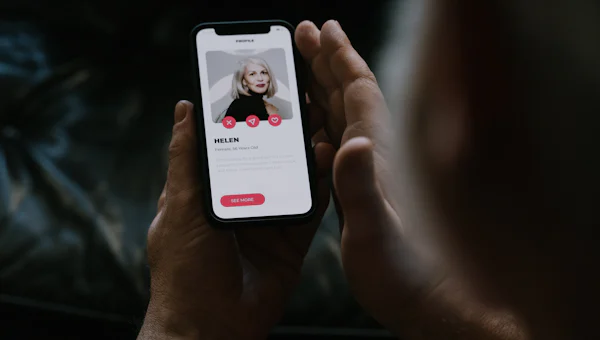
Tinder's daily active user count dropped 10% year-over-year whilst Hinge, its stablemate within Match Group, posted 17% growth over the same period, according to figures disclosed in the company's recent earnings materials. The divergence marks the sharpest split yet between the two products and underscores a generational rupture in dating behaviour that's starting to show up in the financials. What makes the shift particularly pointed: data from a Wells Fargo survey released in March found that 85% of Gen Z singles actively avoid Tinder, citing concerns over safety, authenticity, and the platform's association with casual encounters.
That's not user churn. That's reputational rejection.
Match Group is trapped in a corporate-structure nightmare of its own making. Tinder still generated roughly £480M in revenue last quarter—more than three times Hinge's contribution—which means the company can't afford to let the brand crater, but also can't ignore the fact that its growth engine now lives elsewhere. The fact that both apps report to the same CFO doesn't make this any less existentially uncomfortable.

This isn't a product roadmap problem. It's a brand crisis wearing a product roadmap disguise.
Create a free account
Unlock unlimited access and get the weekly briefing delivered to your inbox.
Cannibalisation or succession planning?
The dynamic puts Match Group's portfolio strategy under unusual strain. When Bernard Kim took over as CEO in May 2023, he inherited a flagship that accounted for roughly 32% of company revenue but was already visibly losing cachet among the demographic it once defined. His response has been to push Tinder towards what the company calls 'intentional dating', a repositioning effort that includes heavier investment in safety features, verification tools, and recently tested AI-driven matchmaking capabilities.
The problem is that Hinge already owns that lane. According to data from Sensor Tower, Hinge overtook Tinder in US App Store download rankings in Q4 2024 for the first time since the app's acquisition in 2019. The gap has since widened. March 2025 figures show Hinge maintaining a 23% lead in new downloads among users aged 18–29 in the US and UK markets combined.
Hinge's growth is occurring at the exact moment Tinder is haemorrhaging its youngest cohort.
That's the core tension. Match insists the two products serve different use cases, but survey data from Pew Research published in February suggests otherwise: 68% of Hinge users and 71% of Tinder users both describe their primary goal as finding a long-term relationship. The distinction, it seems, is less about user intent and more about brand perception.
The AI distraction
Match has floated the idea of an AI 'wingman' feature for Tinder—a conversational assistant designed to help users craft better messages and navigate early interactions. The company described the tool as part of its broader AI integration roadmap during its February earnings call, though it stopped short of committing to a launch timeline or confirmed rollout.
Whether AI can solve a brand problem is debatable. Tinder's issue isn't that users lack conversational prompts. It's that the platform has become synonymous with a mode of dating that an entire generation now views as outdated or distasteful. Features that improve the mechanics of swiping don't address the fundamental question: do people want to be on Tinder at all?
Competitor movement suggests the answer is no, or at least not in its current form. Bumble has leaned into female-first messaging and relationship intent for years, though its own growth has stalled—Q4 2024 revenue grew just 3% year-over-year, according to the company's most recent disclosure. Smaller entrants like Thursday, which limits usage to one day per week, and Feeld, which serves non-monogamous and kink communities, have carved out defensible niches by rejecting the swipe-everything model entirely.
The broader trend is fragmentation. Singles increasingly want platforms that reflect specific values or lifestyles rather than generic access to a large pool. Tinder's scale—75 million users globally as of Q4 2024—once served as its primary moat. That moat now looks more like a liability.
What's actually driving the exodus
The Wells Fargo data is worth sitting with. An 85% avoidance rate among Gen Z doesn't suggest mere preference for competitors. It suggests active rejection. Respondents cited safety concerns, lack of meaningful connections, and Tinder's association with hookup culture as primary reasons for staying away. Those aren't product complaints. They're cultural judgements.
Match has responded with verification features, photo authentication, and in-app video chat—tools designed to signal safety and seriousness. Adoption has been slow. According to data shared during the company's February earnings presentation, fewer than 40% of Tinder users have completed profile verification despite repeated prompts. Users either don't trust the features to work or don't believe Tinder is the kind of place where they matter.

Hinge, meanwhile, has built its entire brand architecture around the opposite premise. The tagline 'designed to be deleted' explicitly frames the app as a means to an end rather than an entertainment product. Prompts replace bios. Profiles emphasise personality over photos. The design choices signal intentionality at every turn, and the growth figures suggest the message is landing.
Match Group's challenge, then, isn't how to make Tinder more like Hinge. It's whether Tinder can be salvaged at all without alienating the users who remain—many of whom still value the platform precisely because it's low-commitment and visually driven. The company is trying to serve two audiences with one product, and the data suggests it's losing both.
What happens next hinges on whether Match treats this as a temporary dip or a structural realignment. If the former, expect continued investment in AI and feature parity between Tinder and Hinge. If the latter, watch for a clearer segmentation strategy—one that accepts Tinder's decline as the cost of Hinge's ascent and adjusts revenue expectations accordingly. Given that Tinder still accounts for nearly a third of Match's total revenue, that's not a decision the company can make lightly. But the longer it waits, the less choice it will have.
- Match Group faces a brand crisis, not a product problem—Tinder's cultural rejection by Gen Z cannot be solved through feature updates or AI integrations alone
- Watch for Match's strategic decision: continue investing in Tinder's repositioning or accept managed decline whilst scaling Hinge as the primary growth engine
- The dating app market is fragmenting towards values-based platforms—scale and user volume are becoming liabilities rather than competitive advantages
Comments
Join the discussion
Industry professionals share insights, challenge assumptions, and connect with peers. Sign in to add your voice.
Your comment is reviewed before publishing. No spam, no self-promotion.